

Adopted by the ENCJ Executive Board on 13 November 2025
ENCJ Gender mainstreaming and non-discrimination policy
Equality is one of the core values of the European Union under the Treaty of the Functioning of the European Union (TFEU) Article 8, which states that: in all its activities, the Union shall aim to eliminate inequalities, and to promote equality, between men and women. In 2020, the European Commission adopted a communication No. COM (2020)152 on “A Union of Equality: Gender Equality Strategy 2020-2025”, making a promotion of gender equality between women and men the task for the Union in all its activities, required by the Treaties. European Institute of Gender Equality underlines that gender mainstreaming ensures that policy-making and legislative work are of higher quality and have a greater relevance for society, because it makes policies respond more effectively to the needs of all citizens.
Next to gender neutral legislation, gender mainstreaming is viewed as a best-suited approach to achieve gender equality. The Commission thus declared that it will enhance gender mainstreaming by systematically including a gender perspective in all stages of policy design in all EU policy areas, internal and external. On the level of projects, the Commission views gender mainstreaming as a tool to reach gender equality by including a gender perspective throughout all phases of the project (design, implementation, monitoring and evaluation).
ENCJ's continued commitment to gender mainstreaming and non-discrimination policy
The ENCJ has been committed to non-discrimination, promotion of gender equality, equal opportunities, and inclusiveness since its establishment in 2004. Even though, to date, the ENCJ has not yet adopted a document setting these important policy commitments, the principles and considerations of gender equality and gender mainstreaming have consistently been applied in the ENCJ's operation (on both internal and external levels), and have been monitored and evaluated. The gender equality component has always been considered integrated in the ENCJ’s activities. The latest gender split data (see below) stands as a testimony to this ongoing commitment.
ENCJ gender representation in figures
While, according to the ENCJ Statutes, each ENCJ member shall determine the participation of its representatives in the activities of the association, in the call for registration for project teams, the ENCJ asks each member and observer to delegate the experts in a manner that gender balance is maintained in their overall participation at the ENCJ activities. When a possibility of appointing several members to a particular project group exists, the ENCJ requests gender balanced participation.
The ENCJ has also monitored whether participation in in-person or online events could be regarded as more favourable to a particular gender (due to possible time constraints), however, no difference was detected, as the choice to participate online or in-person is primarily linked to the schedule of the hearings of a judge.
When a call for candidates for the Executive Board or the Presidency is published, the ENCJ members are always called upon to consider gender equality.
The latest gender split data is a testimony that the toolbox used by the ENCJ to encourage gender equality and non-discrimination is working.
In 2024, the total number of participants who attended ENCJ events was 780, out of which 445 were women and 335 men. The ENCJ Executive Board after the General Assembly 2024 consisted of 3 women and 4 men, with the ENCJ President being a woman.
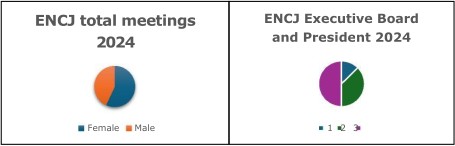
An analysis of participation in the ENCJ activities and organs in 2024-2025 (see the charts above) shows a balanced representation, therefore, the ENCJ will continue to apply the current toolbox and will closely monitor the situation.
In accordance with the European standards for the Councils for the Judiciary, the majority of the members of the Council should be judges selected by their peers. It is therefore not possible to influence the gender balance process in this regard. However, since the beginning of 2023, a number of the ENCJ Members (Croatia, France, Italy, Portugal, Romania) were newly composed.
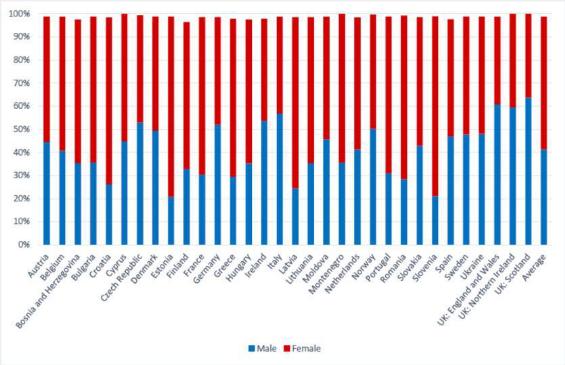
On this occasion, it was found opportune to analyse gender representation within Councils for the Judiciary. The data collected in 2023 provided the following overview:

The data indicate a varying situation among the ENCJ members with respect to gender balance. There are notable examples where a perfect gender balance is achieved and in the majority of the ENCJ members, it is relatively balanced, data from some of the Councils (NCAs) show that balance is lacking. The ENCJ will gather a new set of data at the beginning of 2026, when a new composition of several Councils will be elected.
When the ENCJ organises conferences or other events with panels of speakers, it strives to have gender-balanced panels. The same applies when ENCJ appoints representatives to project teams or project coordinators.
In accordance with the ENCJ Communication Plan, the ENCJ communication uses gender neutral and gender inclusive language. This applies to formal communication, communication on the ENCJ website and social media. In addition, before publishing the ENCJ reports, they are reviewed by a staff member from the perspective of gender equality and inclusivity. When a visual is published alongside the communication, it aims to reflect fair and balanced gender and diversity representation. This principle is also considered when selecting individuals to represent the ENCJ at events.
When possible, efforts are made to communicate in accessible and barrier-free formats for the ENCJ tools. In 2025, for the first time, the Survey among Lawyers on the Independence of Judges will be carried out in barrier-free format.
A separate analysis from the gender perspective was done in the framework of the Survey among Judges on their independence 2025 (see participation by gender in the graph below). The results have shown a slight difference, with the overall responses showing a marginally higher representation or response rate of female judges. It must also be noted that the results of the Survey show that there are no differences in the perception of independence among female and male judges.
Aim of the Gender Mainstreaming and Non-Discrimination Policy
By adopting this Gender Mainstreaming and Non-Discrimination Policy, the ENCJ reaffirms its strong commitment and dedication to gender equality and non-discrimination. This policy document outlines the steps that will be taken and instruments that will be used to monitor the situation as well as to nourish and promote gender equality in the network. Including, but not limited to, the actions outlined above, which are already a part of the ENCJ’s culture. The aim of this paper is to outline the practices used by the ENCJ to take a further step toward promoting better gender balance, making its efforts more visible and better communicated, with the main goal of ensuring equal gender representation and non-discrimination.
To put the above into practice, the ENCJ will take actions under the principles outlined below:
• Zero tolerance for discrimination
Aim: To commit to an environment with zero tolerance for discrimination.
Action: The ENCJ will actively promote a culture where any form of discrimination is not tolerated and has no place within the network. To the extent available to the network, the ENCJ will promote inclusivity for a diverse representation in all of its activities.
• Gender equality
Aim: To promote a shared commitment to gender equality for a more equal and inclusive environment
Action: ENCJ aims to make real change by promoting and raising awareness of gender
equality and non-discrimination through support, cooperation and open dialogue with judicial
councils and other similar bodies.
• Use of gender neutral language in the ENCJ communication
Aim: To promote respect and gender equality through inclusive communication.
Action: Gender neutral and inclusive language will continue to be used in all ENCJ communication. Word choices that may be interpreted as biased, discriminatory will continue to be avoided. Respect for people of all backgrounds and genders and inclusion in the
Network work will be ensured. An ENCJ Office staff member will review ENCJ reports and other public documents from the viewpoint of gender neutrality.
• Gender balanced composition in the ENCJ activities/projects
Aim: To promote equal representation in participation in the ENCJ activities.
Action: In accordance with the ENCJ Statutes, each ENCJ Member shall determine the participation of its representatives in the activities of the Association. In the call for registration for the ENCJ activities, the ENCJ Office shall continue to call for a gender balance in the overall participation in the ENCJ activities. If it is possible to have more than one representative in the working group, a gender balance will be requested.
• Balanced Participation in the ENCJ organs
Aim: To ensure balanced gender representation in the management of the Network.
Action: The ENCJ organs (Executive Board and Presidency) are elected by their peers. When a call for candidates for the Executive Board or the Presidency is published, the ENCJ Members will be called upon to consider gender equality. Furthermore, the ENCJ Members and Observers will be called upon to send a gender balanced delegation to the ENCJ General Assembly.
• Gender balanced panel compositions at ENCJ events
Aim: To promote equal representation among speakers at the ENCJ events.
Action: When the ENCJ organises conferences with panels of speakers, it shall strive to have gender-balanced panels. The ENCJ Office and Executive Board will proactively seek gender equal representation, both when the panels are made from internal (within the ENCJ community) and external speakers.
• Periodic Evaluation
Aim: Periodic assessment of the effectiveness, impact, and improvement of the relevance of the Gender Mainstreaming and Non-Discrimination Policy.
Action: The ENCJ will monitor the gender balance situation in the work of the network yearly. The ENCJ will monitor the gender balance situation on the level of National Councils for the Judiciary every 3-5 years (the average term of the Council is 4 years).
Monitoring effectiveness and updating this policy
To keep this policy actual and up to date, the ENCJ will continue to monitor the situation and adapt the list of outlined actions, as necessary. First, the ENCJ will analyse the situation of gender balance through yearly monitoring. Secondly, on the basis of the results, the ENCJ Executive Board will review and discuss the situation and decide whether some of the outlined actions need to be tailored or additional actions should be taken.